
Horse Portage
Memories of the Quetico

“Why is it called Horse Portage?” I asked. It couldn’t possibly be named for horses. Travel in the interlocking lakes of the Quetico was only by canoe. Passage from one lake to the next was accomplished by portaging one’s canoe and supplies across narrow spits of land that separated the innumerable lakes. No place a horse could go, as welcome as one might be.
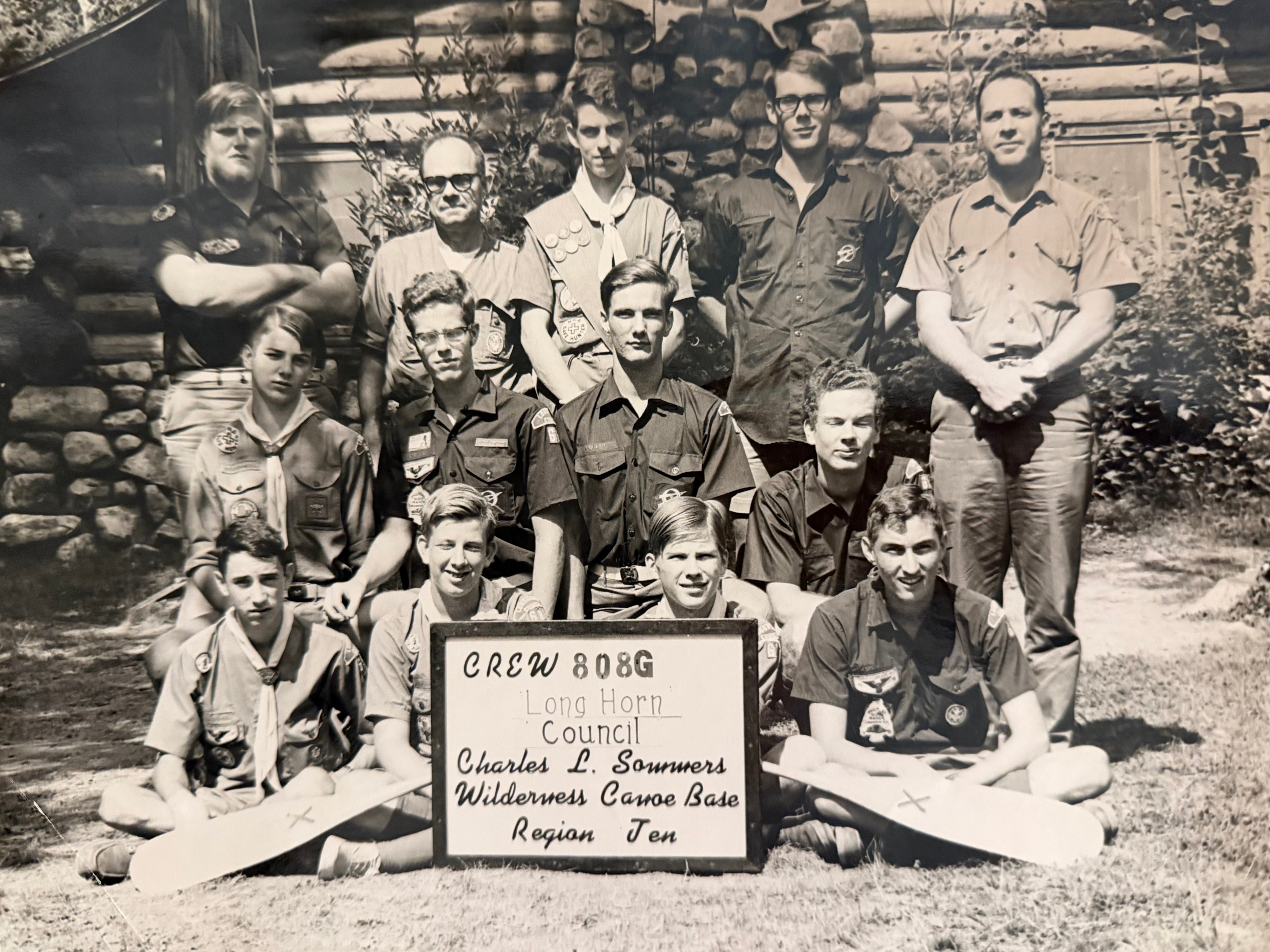
I was a sixteen-year-old Eagle Scout on what we called a “high adventure trip.” My fellow Scouts and I had traveled two days by bus to the Charles L. Sommers Wilderness Canoe Base to become Crew 808G. Sommers Canoe Base was our entry point into Canada’s Quetico Provincial Park, a remote million-acre wilderness extending 150 miles along the U.S. Canada border, with no civilization and over 1,100 lakes.
“The Voyageurs named it Horseshoe Portage because it’s a shortcut across a horseshoe-shaped curve in the Basswood River,” Pheasant replied. Pheasant was the affectionate nickname of our 19-year-old redheaded guide who’d grown up in Minnesota and paddled the Quetico since childhood. In Texas we’d have called it Horseshoe Portage. But this wasn’t Texas. Far from it. The Quetico was like nothing I had ever seen.
We were nearing the end of our 10-day trek that covered over 100 miles, paddling across more than 40 lakes including 15 exhausting miles up Agnes Lake against the wind. It was hard work. The stern paddling position was the most tiring. The job of the stern paddler was to keep the canoe going straight without paddlers switching sides. This required use of the J-stroke, so named because at the end of the stroke, the paddle is rotated outward to push water away from the canoe and counteract the canoe’s tendency to veer. Without an effective J-stroke, the canoe would zigzag across the lake, doubling the paddling distance. Correct use of the J-stroke kept the canoe on a straight course and resulted in aching arms at the end of the day.
After crossing each lake, we carried our canoes and all our gear across land into the next lake, following a portage path. These primitive trails were filled with voracious mosquitoes and were often muddy, obstructed by downed trees and sometimes difficult to follow. To minimize the agony of mosquito attacks, we endeavored to get across each portage as quickly as possible. Thus, we made just one trip. In each three-man canoe, one person carried a food pack, another carried the pack with personal gear and tents, and the third carried the canoe.
The trick to portaging a canoe by yourself was the one-man flip. At the portage trailhead, you waded into knee-high water, pulled the canoe onto your thighs, reached to the far gunnel with your right hand, and then with a single motion, used your left arm to flip the canoe up over your head so that the middle thwart came to rest on your shoulders. Then you could walk out of the water and proceed along the portage trail with a 75-pound canoe balanced on your shoulders, tilting the bow up so you could see where you were going. Once you arrived at the end of the portage trail, you waded back into knee high water and reversed the procedure, gently lowering the canoe sideways into the next lake.
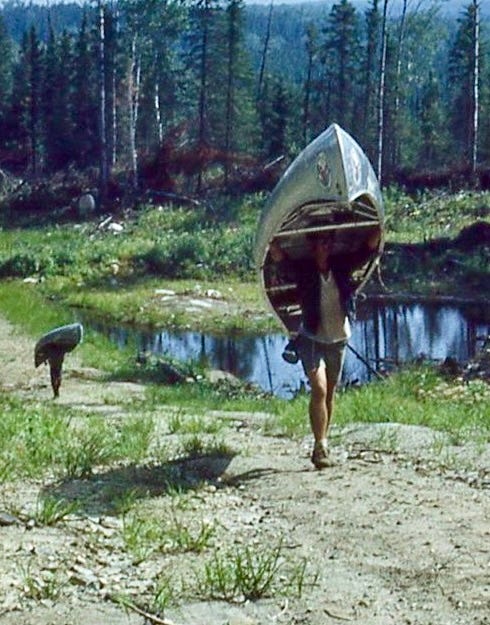
I was one of the older members of our 12-man crew and was determined to be a canoe carrier. I mastered the flip on the second day, after falling and dropping the canoe at all three of our portages on our first day out. I was happy to finally learn and perform such a difficult task requiring strength and special coordination.
After each long day of paddling and portaging, we typically camped on an island, exhausted and hungry. We became proficient at setting up tents, cooking and cleaning up, then snuggling into our sleeping bags by dusk. The next day we’d be up at dawn, pulling on wet boots and quickly eating a hot breakfast before striking camp and setting off again.
Our trek had been the most physically demanding week of my life. But in many ways, it had also been the most satisfying. The scenery was stunning, like none I’d ever experienced in Texas. The water was pristine and blue, safe to drink right out of the lakes. And the wilderness was so remote, a place where one forgot about civilization. We were alone, not having seen a single human in seven days. No phone, no radio, no artificial lights, none of the busyness or worries of modern life. At night the stars and moon were close enough to touch, and the only sound would be the mournful call of a loon or hoot of an owl.
Now we were near the end of this special time and place that had tested our endurance and strength. Just two more nights. Tomorrow would be the most challenging day of the trip. A very long day with many portages, lakes and a river. We would say goodbye to beautiful Argo Lake and cross a muddy portage into Crooked Lake. After several hours paddling around peninsulas and islands, we would portage around Lower Basswood Falls, enter the narrow Basswood River and paddle upstream to the legendary Horse Portage. From there it was a long paddle down Basswood Lake into Wind Bay followed by a final half-mile portage into Wind Lake. We would spend our final night there before returning to the Sommers Canoe Base.
“Horse Portage is one of the longest portages in the Quetico,” Pheasant said over supper, “400 rods.” In the Quetico, portage distances were measured in rods, an archaic English measure equal to 16.5 feet or 5.5 yards. I did the math in my head and determined it was about 1.3 miles. “There are canoe rests halfway,” he added. A canoe rest was a horizontal pole tied between two trees, about eight feet above the ground where you could rest the bow end of the canoe, set the stern end on the ground, step out and rest before carrying the canoe the final part of the way.
“No canoe rest for me,” I announced. “I’m going to carry the canoe the whole way across Horse Portage without putting it down.”
Pheasant frowned. “It’s a long portage and there’s some uphill sections. More than twice as long as any portage we’ve done.”
Everyone was silent. Then Kenneth suddenly exclaimed, “Me too.” Kenneth was another sixteen-year-old, as skinny as me.
Pheasant eyed me and then Kenneth. Kenneth was a stubborn kid who had spoken little during our trip. Pheasant brushed red hair away from his eyes and added, “It’s an exhausting portage. No shame in resting halfway, that’s what everyone does.” Kenneth glanced at me and nodded.
We broke camp early the next morning. The water on Argo Lake was completely still, reflecting a mirror image of our canoes and the rising sun peeking above the eastern shore. I had come to love this sacred place and what it had revealed to me, about myself and my place in God’s creation. We were quick down Argo, across the portage into Crooked Lake, then onward and across the portage around Lower Basswood Falls. We could feel the Basswood River’s current against us, but we were now experienced and strong paddlers. We soon arrived at Horse Portage.
My two companions exited the canoe, quickly donned their packs and were off. As I was pulling the canoe onto my thighs and preparing to flip, Kenneth was doing the same. “Here we go,” I grunted when hoisting the canoe overhead, and started up the grassy portage trail. I heard Kenneth flip his canoe and the sloshing sounds of his boots exiting the water just behind me.
Indeed, it was a long portage. The mosquitoes weren’t yet out, and I could concentrate on maintaining my balance on the wet grass. Onward, up over a steep hill and then around a curve. I turned east, leaving the coolness of the river behind and entering thick vegetation on either side of the trail. My legs and shoulders were aching when I sighted the first canoe rest. One of my companions had dropped his pack and was sitting, gulping from a canteen while trying to catch his breath. I paused and yelled to Kenneth behind me, “How you doin’ Kenneth?” His only reply, “Keep goin’.”
We were over halfway. Onward, onward. My thighs quivered with exhaustion, sweat dripped down my face, my heart thumped quickly in my chest. A mosquito’s buzz was amplified by the canoe surrounding my head. Its proboscis pierced the skin of my neck, but I was too tired to swat it away. Kenneth stumbled behind me and his canoe scraped against the brush that lined our narrow path. “We can do this,” I shouted, hoping to encourage us but feeling doubtful. How much further? Should I set the canoe down, in the middle of the trail, before I fall or drop it from exhaustion? Dropping a canoe on the ground was a huge no-no, it could fatally damage the vessel that provided our only way home.
Now I was counting my steps. 100 – 200 – 300. I can’t go much further. Where can I set this canoe down? Suddenly I heard voices and splashing of boots. Then an image of blue water sparkled through green branches. I shouted, “We’re here.” I stumbled to the shore and summoning my last bit of energy, reverse flipped my canoe and lowered it into the waters of Basswood Lake. In less than a minute Kenneth did the same. We hugged each other and wordlessly sat down in mud. My pants were wet, but I didn’t care.
Five decades later, from the bottom of a dusty cardboard box, Crew 808G stared back at me. I smiled at the glossy black-and-white photo and the memory of carrying a canoe across Horse Portage. I recalled my pride in accomplishing something that was really difficult, and my reverence for that magical place. The Quetico, where I learned to paddle the J-stroke and flip a canoe; and where a skinny sixteen-year-old kid transitioned from adolescence to adulthood.
Author’s note: The photo of me carrying a canoe was taken by my dad in August of 1968. This was not Horse portage but another one, into Sturgeon Lake.
Great story Rush, beautifully written. Perseverance, privation, pride. A classic young man's coming of age story, compellingly told. Thank you.