
Death with Dignity
What does that mean?

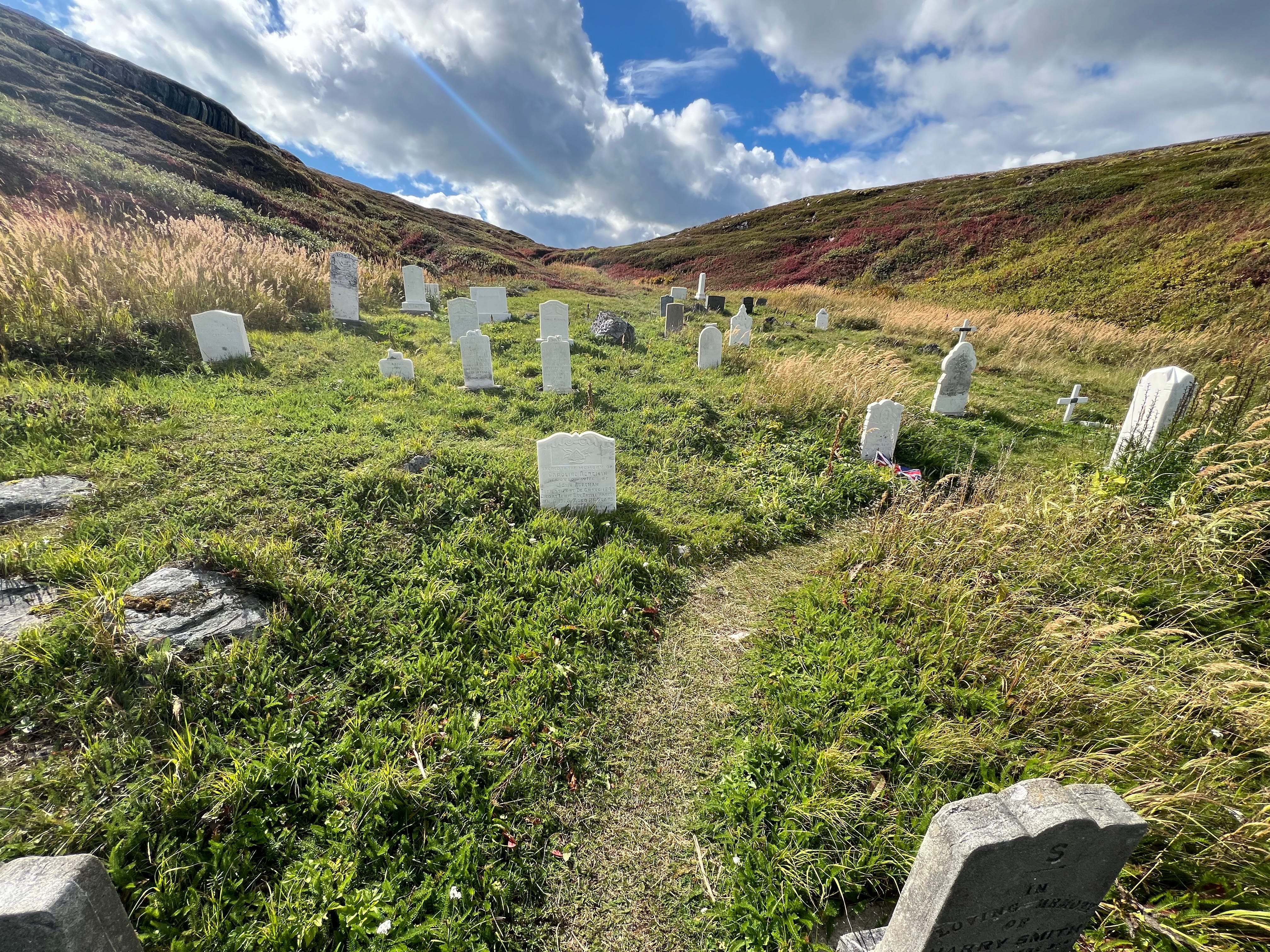
Community cemetery. Battle Island, Newfoundland and Labrador, Canada. Photo by the author, 20 September 2025.
My hospital rounds had taken longer than usual. Despite my early start, it was now late-morning. I had deliberately seen my other patients first, so as to have unhurried time with Frank and his wife, Lorie. The nurse told me that Frank’s priest was visiting. I slowly opened the door and entered noiselessly. I smiled at the sunlight filling his room. Several days earlier, when his despondency was at its worst, I had suggested to Lorie that we open the curtains, thinking that sunlight might boost Frank’s spirits.
The priest was kneeling and praying at Frank’s bedside with his hand on Frank’s head. It was the first time I had observed Last Rites, the Catholic sacrament delivered to the dying.
“In the name of the Father, and of the Son, and of the Holy Spirit. Amen.
“I commend you, my dear brother, to Almighty God, and entrust you to your Creator. May you return to him who formed you from the dust of the earth.
“May holy Mary, the angels, and all the saints come to meet you as you go forth from this life. May Christ who was crucified for you bring you freedom and peace. May Christ who died for you admit you into his garden of paradise. May Christ, the true Shepherd, acknowledge you as one of his flock. May he forgive all your sins, and set you among those he has chosen. Amen.
“Eternal rest grant unto him, O Lord, and let perpetual light shine upon him. May he rest in peace. Amen,” the priest concluded.
The priest placed a bit of oil on Frank’s forehead, made the sign of the cross, and stood. Frank lay unmoving and with eyes closed, oblivious to the priest’s ministrations. I noted Frank’s irregular respirations and mottled skin. It’s good the priest came this morning. If he’d delayed until this afternoon, it would probably be too late. The priest turned to Lorie and their two daughters, who were silently weeping. Lorie thanked him for coming. “It means a lot to us.” Then she noticed me in the doorway. “Oh, Father George, this is Doctor Pierce, Frank’s doctor.”
Frank had become my patient shortly after I started my practice, me a young doctor and he a young banker, both of us new to town and just beginning our families and our professional lives. His initial visit was prompted by severe pain in his right great toe, so much so that he’d been unable to sleep the night before. Even the weight of the bedcovers exacerbated his pain. Frank’s gout was an easy diagnosis, but he thought I was a miracle worker. My prescription resulted in almost immediate relief of his pain and prevention of subsequent episodes.
With Frank, gout had been easy. But his final illness was hard. Lorie later told me she thought it started the day of their twentieth wedding anniversary, when they were out for a special dinner. “He hardly touched his food. When I asked him what was wrong, he smiled and said that contemplating how much he loved me had taken his appetite away.”
Unfortunately, love wasn’t causing his anorexia. A few months later Lorie commented on Frank’s weight loss. “It’s nothing,” he said. “Doctor Pierce has been after me for years to lose weight. I’m finally getting healthy,” he said with a smile. Then there was morning vomiting and pain in his back. She thought his color was bad and she insisted he see me. He disagreed, “No need to bother the doctor, I’m fine.” When he fainted in the bathroom she declared, “There’s nothing fine about this,” and dialed 911.
I went to Frank’s bedside, a metal gurney parked behind white curtains, ineffective in their attempt to provide privacy in the noisy Emergency Room. He kept apologizing. “So sorry to bother you, Lorie’s worried about nothing.” His blood pressure was low. My exam noted scleral icterus and epigastric tenderness. Lorie’s worrying turned out to be justified. An urgent abdominal CT scan revealed the hidden man-eater—a large pancreatic cancer that was obstructing his biliary drainage and that had metastasized to his liver.
Frank wanted aggressive treatment. “I’ve always been a fighter. I owe it to my daughters.” Now eighteen months later, after surgery, failed chemotherapy and three unsuccessful experimental treatments, death was loudly knocking at the door. Frank had more difficulty accepting this than Lorie. “I’m only 47 years old, I’m not ready to die,” he’d told the oncologist. “I’m so sorry Frank, there’s no other treatment options,” was the oncologist’s response.
That’s when Frank and Lorie came to see me.
“So I guess I’m near the end of the line,” Frank said.
I paused. “So given that reality Frank, what do you want?”
With moist eyes, Frank glanced at Lorie and then at me. “I want to be rid of this pain. And I want my family and friends to see me as someone other than this diminished person that I’ve become, an object of pity and a source of burden. Jesus Christ, Lorie had to quit her job just to take care of me. I can’t even dress myself anymore. She has to help me shower and get into bed. I’ve always been able to take care of my business and my family. Now I can’t even take care of myself.” He swallowed hard and continued. “It’s so humiliating and depressing. What I want Doctor Pierce, is to die with dignity. And right now, my life doesn’t feel very dignified.”
Death with dignity. What does that mean? One year before, Oregon voters had approved the Death with Dignity Act, allowing Oregonians with a terminal illness to obtain prescription medications to self-administer when they were ready to die. The premise is rooted in the bioethical principle of autonomy: a patient’s moral right to make medical decisions for themselves. Oregonians had decided this included allowing terminally ill persons to choose the timing of their death, providing them with a more controlled end-of-life experience than a potentially painful alternative with an uncertain end time. Oregon’s law offered the promise of control. But did that assure dignity?
Frank lived in Texas so that option wasn’t available to him. Lorie touched Frank’s face, smiled and softly said, “Frank, I’ll admit that caring for you has sometimes been hard. But it has never been out of pity. It has always been out of love and respect. And Sweetheart, love and respect is the essence of dignity. For us both.”
Frank continued to lose weight and muscle mass. Once handsome and athletic, he was now pale, with thin skin, boney features and yellowish eyes, an ugly apparition of his former self. He became increasingly dependent on Lorie and his teenage daughters for basic activities of living: bathing, feeding, and then even toileting. He hated his loss of independence, a source of despondency and an affront to his pride and sense of self-esteem.
When we could no longer control his pain and agitated delirium at home, I admitted Frank to the hospital. After several days and many medications, he was finally calm and mostly lucid. Two days of heartfelt conversations with family and friends followed. Then he became unresponsive and began actively dying.
I was at his bedside with Lorie and his daughters when Frank’s final departure came, just a few hours after the priest administered Last Rites. We shared a final prayer, hugged one another, and reminisced. I recounted Frank’s first office visit with a painful, swollen toe that resulted in his nicknaming me “The Miracle Worker.” We all laughed. Frank’s daughter added, “And he didn’t like his 19-year-old daughter cleaning his bottom side, but he got over it,” she said with a smile. Then she paused, wiped her eye and added with a broken voice, “Caring for Daddy these last few weeks has been the greatest honor of my life.”
Now Frank was dead—the end of the line he’d called it. Only a few deaths I’ve witnessed were quick and merciful. Many were like Frank’s, a slow, dreadful descent into frailty, dependence, and anhedonia, until everything that makes someone a vital being melts away, leaving behind just a fragile shell of what used to be. Then that too evaporates, and only memories remain.
I recalled the priest’s whispered words earlier that morning: “Eternal rest grant unto him, O Lord… May he rest in peace.” Yes, death had granted Frank eternal rest and peace. Did it also confer dignity?
One of your best essays, Rush. Take care.
Thought provoking and touching article. Do you think he would have chosen assisted suicide if it was available to him? What other options could have been offered? Perhaps home care so he could be spared the embarrassment of dependency on his loved ones. Yet, they appreciated being able to support him and provided a connection they would never have experienced. I suppose if we could learn to accept the gift of that kind of support from family members, dignity would be maintained. Dignity: the state or quality of being worthy of honor or respect. Those caring for him certainly thought he was worthy so maybe it's more about our ability, if in his position, to be vulnerable and accept love and care.